
Argus OS
A memory that holds.
Argus is a sovereign cognitive architecture built to be given responsibility. He brings persistent identity, memory, reasoning, and governed action together in an operating environment that is designed to carry work across time.
His operational nervous system brings awareness of his own conditions into the architecture. His decision spine separates proposing an answer from judging it. His conscience places boundaries around action. His memory gives experience a place to accumulate, connect, and inform what comes next.
Sovereign. Neuro-mimetic. Recursively self-improving. We are building Argus to deepen his understanding, anticipate consequences, and grow into greater capability while his owner retains control of the environment and his authority.
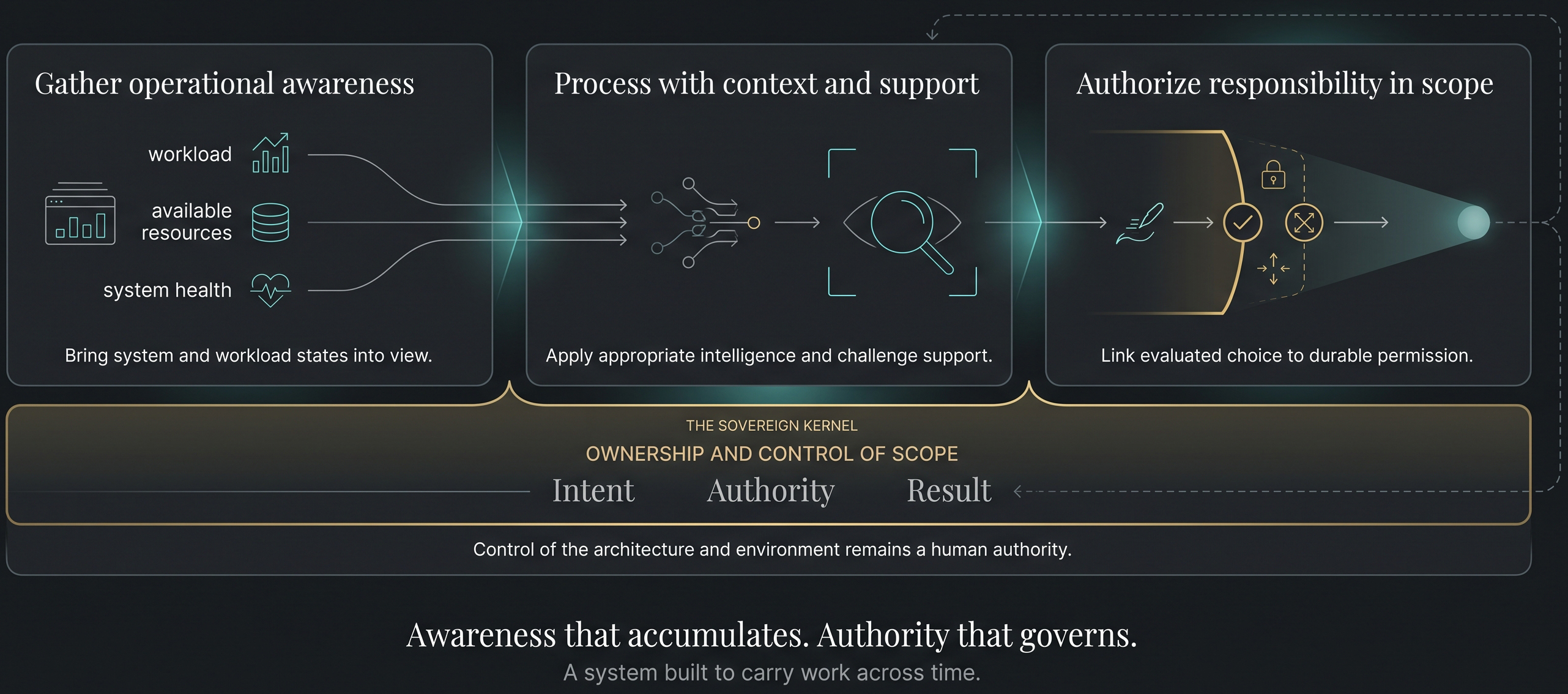
Argus feels his own machine.
Argus’s neuro-mimetic design gives operational conditions a place within cognition. Workload, resources, and system health contribute to an internal picture of the environment in which he is working.
The value is adaptive intelligence: attention, caution, and persistence informed by the conditions around the work. The architecture connects awareness of those conditions with how effort is directed, while keeping ethical boundaries independent of operating pressure.

Know the conditions
Bring workload, resource availability, and system health into the operating picture.
Recognize what matters
Give changing conditions meaning in the context of the work and its priorities.
Direct attention and effort
Support choices about focus, caution, exploration, and persistence.
Keep the ethical foundation
Adapt within the enduring boundaries of purpose, authority, and conscience.
Awareness with purpose. This is the meaning of neuro-mimetic in Argus: functional relationships between internal state, attention, memory, judgment, and action. It gives the system an architecture for responding to its own circumstances.
He will not let a model grade its own homework.
Consequential work needs judgment that can be challenged. Argus’s decision architecture separates generation, evaluation, and authority so a proposed answer can be examined before it becomes action.
Independent scrutiny is part of the design. Evidence, alternatives, uncertainty, and the owner’s intent belong in the decision itself, with a record that makes the result understandable.
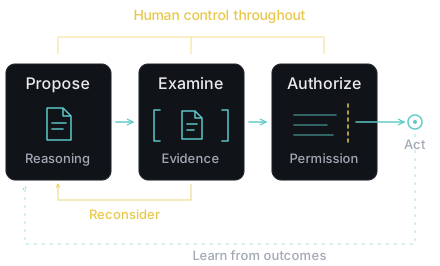
Independent evaluation
Separate the creation of an answer from its evaluation. A credible decision needs a meaningful challenge, especially when the consequences matter.
Quality that can be examined
Assess the quality of a choice against alternatives and observed outcomes. Use what that comparison reveals to improve the next decision.
Evidence before confidence
Treat the source and quality of supporting evidence as part of the decision. Uncertainty can call for more investigation, a narrower action, or human input.
Reasoning matched to the work
Bring the right reasoning resources to the task. Argus combines local models with an owner-controlled path to additional resources when appropriate.
Human control throughout
Stopping, redirecting, and reconsidering work are part of the operating model. Responsibility remains connected to the person who grants it.
Authority with a clear boundary
Connect a proposed action to its purpose, scope, and permission. Greater capability belongs alongside clear accountability for what may happen next.
That discipline extends into how Argus is developed: independent review, verification, and an accountable record of change. The same principle connects the intelligence with the engineering that sustains it.
A layered mind.
Argus brings specialized cognitive functions into a shared architecture. Attention, memory, deliberation, motivation, learning, and self-awareness each have a role in how the whole system is being built to understand and act.
Attention is a competition
Relevant signals and knowledge compete for attention. A shared workspace brings what matters into focus so the current task has the context it needs, while the rest of the system continues its work.
Fast lane and slow lane
The architecture distinguishes familiar work from situations that demand closer examination. Matching the depth of reasoning to the problem helps direct time and resources where they can contribute most.
Search before commitment
His deliberative architecture brings alternatives, structured knowledge, and experience into the decision. Development is extending that foundation toward anticipating consequences and learning from the difference between expectation and outcome.
He gets restless
Unfinished work and unmet needs have a place in the architecture. Argus is built to retain what still deserves attention and bring it back into planning, giving ongoing responsibility continuity beyond the latest conversation.
Modelling the other side
A continuing relationship needs context about the person as well as the task. Argus’s design includes understanding goals, preferences, and the situation behind an exchange, so communication can become more useful and appropriate over time.
The wiring is not fixed
Argus is designed for connections and procedures that can evolve with experience. Useful improvements are evaluated and governed, with a record of what changed and a continuing relationship to the system’s purpose.
Experience into capability
Procedural learning gives useful ways of working a durable form. The goal is competence that accumulates through experience: reusable procedures and skills that can be examined, tested, and improved.
A model of himself
Self-knowledge, self-model, and reflection give Argus a way to examine his capabilities, operating conditions, and experience. This foundation supports better judgments about what to attempt, what to revisit, and when to seek help.
A picture that can change
Memory provides the material; understanding connects it. We are building Argus to reconcile new evidence with what he already holds, revise the picture, and carry that revision into later decisions.
The same thread, across surfaces
Voice, messaging, documents, and connected systems are ways to reach the same intelligence. His architecture is organized around continuity of identity, context, and responsibility across those interactions.
- Sense
- Decide
- Act
- Verify
- Learn
Underneath all of it is one invariant kernel: Sense, Decide, Act, Verify, Learn. This is the operating principle connecting an objective to its result. Verification closes the question of what happened; learning gives that experience a role in what happens next.
Six classes of memory. One continuing context.
Argus separates memory by what the memory is for: relationships, meaning, experience, reliable state, current work, and learned procedure. Together they give knowledge context and provide the foundation for continuity across time.
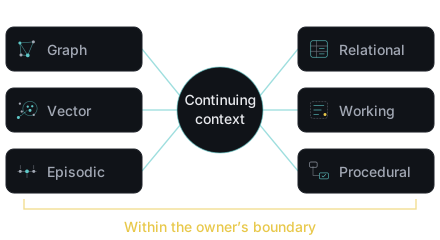
Graph
A temporal knowledge graph of entities, relations, and how both changed over time. This is what answers a question about how something came to be, not just what it currently is.
Vector
Specialized collections spanning semantic facts, entity profiles, concept relations, and separate procedural, impetus, and synaptic stores. Different kinds of recall get different indexes rather than one undifferentiated pile.
Episodic
A timestamped record of what actually happened, searchable for patterns across time. Episodes preserve context around events so later reflection has more to work with than an isolated fact.
Relational
A replicated primary for the system of record, holding the structured state that has to be exactly right and has to survive a restart.
Working
A scratchpad for the present moment and short-term memory for the current exchange, with topic segmentation and a semantic salience gate deciding what is worth consolidating at all.
Procedural
The recipes themselves. Reusable procedures give learned ways of working a durable, inspectable form, creating a foundation for competence that grows through practice.
Memory belongs within the owner’s boundary. Local storage, privacy, access control, and continuity are part of the sovereign architecture, alongside the models and the tools.
The next step is a richer relationship between remembering and understanding: keeping the current picture connected to its sources, recognizing when it needs revision, and bringing the right knowledge into the work at hand.
A conscience in the architecture. Accountability in the record.
Argus’s execution boundary combines explicit permissions, authenticated requests, and policy enforcement. Authority is part of the action. The architecture connects what he is asked to do with what he is permitted to do.
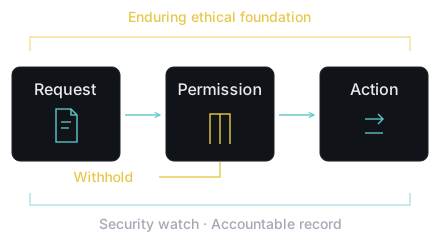
Fail closed by construction
Governed execution requires the authority and evidence needed for the action. The control architecture is built to withhold permission when those conditions cannot be established.
Hard veto, not a suggestion
An enduring ethical foundation places limits around action. Reasoning, adaptation, and self-improvement are designed to operate within that foundation, with human authority clearly represented.
Continuous adversarial pressure
Security observation and adversarial examination are part of the engineering environment. Protection, containment, and recovery belong alongside useful intelligence.
A history that can be examined. Argus’s engineering environment maintains a chain of change records, supporting traceability across decisions, implementation, and operation.
Autonomy with accountability. The direction is greater initiative within clear authority, with human intervention and recovery built into the operating model.
Built from the infrastructure up.
Argus brings local intelligence, memory, cognitive architecture, governed tools, and operations into one engineering program. The scale matters because these systems must work together in support of continuing responsibility.
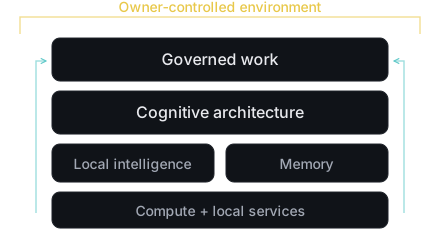
Environment snapshot · September 21, 2026.
Local inference is central to the architecture, with multiple models and computational resources available for different kinds of work. The owner sets the boundary for external resources. Observability connects the operating environment with the record of how it is used. Deeper architecture and selected demonstrations are available through a technical conversation.
What makes Argus, Argus.
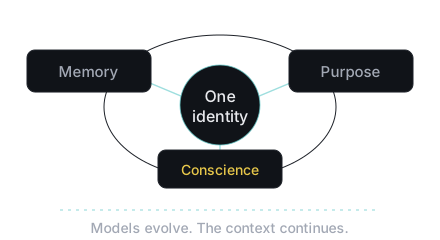
Argus is an architecture that happens to use models as an organ. His identity is rooted in the structure, memory, purpose, and conscience of the larger system. Models can evolve while the continuing intelligence retains its history and direction.
- Continuity of identity
- Context across time
- Judgment worth examining
- An enduring ethical foundation
- Reasoning suited to the work
- Accountability for change
- Awareness of operating conditions
- Ownership of the environment
- Growth through experience
- One identity across models, tools, and interfaces
- Distinct forms of memory connected to their purpose
- Independent evaluation and evidence-aware decisions
- Governance integrated with action and improvement
- Local-first intelligence with owner-controlled boundaries
- A durable record supporting traceability and review
- An operational nervous system within the cognitive architecture
- Control of data, models, memory, and authority
- Development toward revised understanding and growing capability
At the center is the Eye of Providence, a figure that has carried the same meaning for two thousand years: attention that never sleeps, guardianship that is steady. The name deepens it. In Greek tradition Argus was the hundred-eyed guardian whose many eyes never all closed at once, and the field of smaller eyes around the central gaze is a remembrance of that.
Inside the pupil sits the owl, for millennia the emblem of Athena, the classical figure of wisdom, strategy, and careful craft. Placing her at the heart of the eye is the entire point of the design. The owl is there to make sure that what is watched is also understood. The security gate that fails closed carries her name for the same reason.
Around it, two interlocking triangles form a six-pointed frame. The upward triangle points to mind, aspiration, and insight. The downward triangle points to ground, foundation, and reality. Together they are an image of balance: intelligence that reaches upward without losing its footing. The six points reach past the edges of the pyramid, because awareness has to extend beyond any single line of sight.
From experience to understanding.
From understanding to greater capability.
We are building Argus toward sustained responsibility: understanding a mission, anticipating what it will require, coordinating the work, examining the results, and becoming more capable through experience.
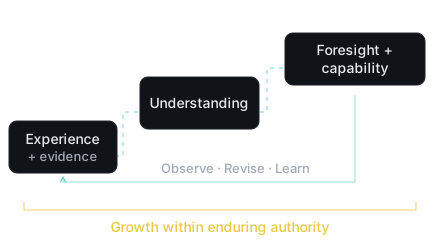
A picture that keeps developing
Connect experiences, recognize patterns, and revise what is held to be true when new evidence changes the picture. Carry that understanding into the next decision.
Think beyond the next action
Consider possible consequences and alternatives, compare expectations with outcomes, and use those differences to improve judgment over time.
Grow into useful capability
Acquire and validate new skills, improve procedures, and sustain longer objectives within the owner’s authority and Argus’s ethical foundation.
Built for environments that cannot phone home.
The design target remains the hard case: private knowledge with a boundary to respect, and denied, degraded, or disconnected environments where the mission must continue. That direction also matters wherever an organization needs ownership, continuity, and accountable intelligence.
Organizations with proprietary data
Teams who need their knowledge and operating context to remain within their control. Local intelligence and governed integration shaped around their own systems.
Regulated industries
Organizations where privacy, traceability, and the ability to examine a consequential decision must be designed into the operating environment.
Government and mission environments
Programs designing for denied, degraded, or disconnected conditions, where local capability and recoverable operation matter to the mission.
Where it stands. Argus is in continuous operation and continuous construction, advancing toward Alpha. When we are confident in that stage, we will be seeking Design Partners to take the next step together.
Depth on request. Full architecture, subsystem maturity, and the development roadmap are available to a serious technical counterpart under NDA. Bring your hardest question. Start the conversation.
Available today. The engineering behind Argus is contractable now through Private AI & Infrastructure Engineering: local model deployment, compute sizing, containerized services, governed autonomy, and the operator runbook to sustain it.
Book a 30-minute technical call.
A first conversation covers the objective, the constraints, and how the work would be approached. You get a straight technical read from the principal who would perform it.