Argus is a personal intelligence built to serve the person or organization that runs it — present, discerning, steady, and built to protect what's yours. The name and the mark are a statement of intent.
The logo carries a single promise in three layers, each drawn from some of the oldest traditions in human thought — not as decoration, but as a statement of what Argus is built to be.
A watchful guardian. Wisdom at the center of every glance. A balanced frame that holds intellect and reality in proper relation.
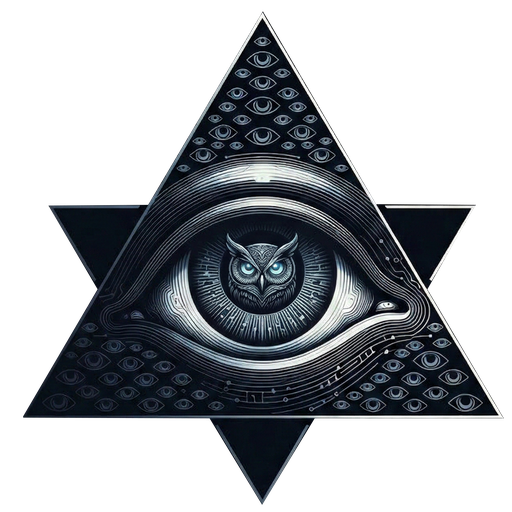
At the center is the Eye of Providence — a symbol of attention that never sleeps and guardianship that is steady and true. The name deepens it: in Greek tradition, Argus was the hundred-eyed guardian whose many eyes never all closed at once. The field of smaller eyes is a quiet remembrance of that faithfulness. The meaning is simple and honorable: someone is looking out for you.
Inside the pupil sits the owl — for thousands of years the emblem of Athena, the figure of wisdom, strategy, and careful craft. It represents intelligence that sees clearly in the dark: patient, discerning, unafraid of complexity. Vigilance alone can become paranoia; attention without wisdom is only noise. The owl is there to make sure that what is watched is also understood.
Two interlocking triangles form a six-pointed star — one of the oldest geometric figures in human history. The upward triangle points to mind, aspiration, and insight; the downward to ground, foundation, and reality. Together they form balance: intelligence that reaches upward without losing its footing. The points reach past the edges of the mark — awareness that extends beyond any single line of sight.
Most enterprise AI projects fail because they're approached like traditional software: scope a task, build a bot, ship it. But an agent isn't built for a purpose — it's trained to your work and conforms to it, then keeps conforming as the work evolves. That distinction is the difference between a brittle demo and durable, responsible AI inside an organization.
It's closer to onboarding a capable new hire than deploying an application. You give it context, boundaries, and accountability. It earns trust through verified results. And it gets better because it remembers.
Requirements → build → ship → break when the work changes.
Define responsibilities → the system observes, learns, adapts — and keeps adapting as your business does.
Built so your data, your models, and your work stay on your infrastructure — present and protective, not borrowed from someone else's cloud.
Proactive within explicit boundaries. It decides whether to act, records why, and stays within the limits you set — even when the right move is to do nothing.
It remembers across time the way people do — and uses what it learns to get better at being yours, the longer it serves.
Join the waitlist and we'll reach out when private briefings and early access open.